Saturday, 15 December 2012

On the End of Term, Ethics Bowl, and Admissions.

Well folks, school is almost out, but you know what they say... it ain't over till it's over!

While I plan to continue posting on this blog in the future (who knew blogging could be so much fun?!) I likely won't be posting as often as I did this term.. but who knows?


As the semester is wrapping up, I thought I'd discuss a few things.

First, I'd like to reiterate how amazing this experience was for me. I have often found that I start a semester with no clue what the prof is talking about and soon find myself enthralled by the very things I didn't understand before. One time I started out with "what does he mean by Mycenaeans and Minoans, and when was the Bronze Age?!"(only to aspire later on that year to dedicate my studies to these very same concepts which had so puzzled me a few months before). This time, it started out with "what does she mean by "conventions" and "cultural heritage" (a question which I think we are ALL still asking ourselves...)?  What started out as a simple archaeology credit became my favourite class of the semester (but shh.. don't tell the other profs that!) and I rave to anyone who will listen about all that we discuss and the things we learn. It's safe to say that this class has been pivotal to my academic career, as it has made me aware of all the issues surrounding archaeology and cultural heritage, issues which I daresay are important to get acquainted with if one is thinking of a career in archaeology (or Museums, conservation, etc). I look forward to further developing my knowledge in this area in the coming years, and would like to acknowledge that none of this would have turned out the same had it not been for Dr. Greene and her enthusiasm for the subject, as well as her encouragement for us to think for ourselves on where we stand on these issues, instead of dictating what we ought to think.

Next on the Agenda: for my classmates and peers, Ethics Bowl anyone? I think it would definitely be more work, but would also definitely be worthwhile (and plus, Hawaii!). I think since a few of us have differing opinions on certain points, that would be a strength as we would bring more knowledge to the table!


And lastly for today, a little bit of controversy.

It is my firm belief that cultural heritage should belong 'to the world,' meaning that everyone who wants to should be able to see the artifacts they desire. While I am aware that this is ideal and in the real world doesn't really work, which is why ownership is usually given to nation-states, I do believe that Museums should be free. Why is it that only certain Museums are? I realize that this is also not the most practical in pecuniary terms, but if Museums have millions of dollars to acquire new antiquities, why can they not have free access to any one who may be willing? Imagine you don't have two extra cents, but are a huge history buff. Shouldn't you be able to see all these artifacts for free? Or if not free, perhaps cheaper? Some Museums are really great with their pricing, but others could cost families a month's worth of groceries.

 For example, if my extended family were to visit from Mexico and we took a trip to New York City, assuming we are eight people (my own family included) and only one of us is still a student, at $25 for the general admission, we'd be spending over 180 dollars to attend the MET for a few hours. That's more than some people pay for a month's rent in Mexico! 

The same should hold true for archaeological sites. If I travel all the way to Jordan, shouldn't I be able to visit Petra without going bankrupt? Let's say that this same family that just visited me then goes on to Jordan, because it is my cousin's dream to visit Petra. Admissions are 50 JD (approximately 70 USD) a person, which for a family of four amounts to 280 dollars. and that's only if they are to be in Jordan overnight. If they were going to Israel and went to Jordan only to see Petra, the entry fee is 90 JD (~125 USD) a person. that would amount to 500 dollars for one day (and that's just the entry fee, which does not include a guide or anything of the sort). The worst part of it all, is that only 10% of this fee goes towards the Petra Archaeological Park. Having actually been to Petra, I must state that the site is incredible, but I don't know if I would return for the price of 70 USD. My suggestion is to go on an archaeological excavation which will gain you free admission to the site.

I think these fees are a bit abusive, especially when Jordanians would pay only 1 JD for admission. These high fees assume that all visitors are wealthy and have mountains of money to spare, and this assumption may perhaps keep interested parties from visiting. I, for one, would be less likely to suggest to my cousins a trip to Petra (there are over 18 of us) than would perhaps suggest a visit to Rome, where the Flavian Amphitheater costs only an approximate 15 USD a person, and the famous forum is free to visit...


Sunday, 9 December 2012

Book Review


           In his book Against Cultural Property: Archaeology, Heritage and Ownership, John Carman challenges the idea that material which comes to us from the past should be considered as ‘property.’ Carman successfully discusses the categories of illicit antiquities and the issues associated with ascribing value to them as if they were ‘property’ in his first chapter, stating his thesis that it is the notion of ownership itself which is the problem in the treatment of ancient remains. 

           The second chapter of the book, therefore, deals with property and property relations. He outlines the four types of property: private, common, state, and open access. While private property provides exclusive rights, common property provides shared rights; state property abrogates all rights to a national government, while open access, although the most loosely defined, ascribes the rights to all individuals, to use for any purpose. He concludes the chapter with a discussion of “propertyless culture,” in which he outlines Hyde’s study of the ‘gift’ and argues that the shift of an object from ‘commodity’ (thus property) to ‘gift’ shifts the object from a realm of use, to a realm of symbolic value. 

           In chapter three, Carman argues that archaeological objects are, and should be useless (in the sense of not needing to be used up as a commodity would be) and also priceless. They are heritage, and not a resource. He therefore argues that if they are used as a resource, they become property, whereas otherwise, they are simply priceless heritage. 

           In the next three chapters, Carman discusses archaeology as property, archaeology as common property, and archaeology as an open-access resource in an attempt to present some ideas as to how to proceed,  followed by a conclusion in the last chapter. 

           It is evident that Carman has experience with law, finance, and commercial administration, yet in his discussion of cultural heritage and archaeology, he only once, briefly, mentions ethics. His disregard of ethics in his discussion is a major shortcoming, as it would have perhaps been instrumental in arguing his position and providing new ideas for the treatment of cultural property. In his discussion of the different categories of illicit antiquities, a brief discussion of the UNESCO 1970 Convention on the Means of Prohibiting and Preventing the Illicit Import, Export and Transfer of Ownership of Cultural Property would further inform the reader of the guidelines for what is considered illicit, and what is not. 

           Lastly, while the book part of a series meant to be accessible to students and scholars alike, Carman frequently talks about “AHM” and the management of AHM in the first two chapters, yet he never defines AHM. After conducting some research, I can reasonably assume that AHM stands for “Archaeological Heritage Management,” however, I could be completely mistaken as it is nowhere defined in the book. 

           Overall, the premise that the ownership of cultural objects is the major problem in the way we conceive, give value to, and treat cultural objects definitely has its merits, and is well argued in the book. Furthermore, Carman acknowledges that there is more than one solution, and personally lays out three possibilities. His major shortcomings are the overlooking of the ethical debate and how it ties into the laws and ideas of ‘property’ and the stakeholders in it, and the accessibility of the book as a single volume of its series. 

Tuesday, 4 December 2012

What is Archaeology and who does it?

Yesterday in class we discussed, among other things, what is archaeology, and who are archaeologists? Some of the questions include: can we call treasure hunters archaeologists? Is it the end-goal that matters, or the methods? 
I would say that it has to be a combination of factors. 

For clarification, the dictionary defines archaeology as "the study of human history and prehistory through the excavation of sites and the analysis of artifacts and other physical remains."
Entries from different dictionaries all include either the words "scientific" or "systematic" along with "study." 

So, are treasure hunters archaeologists? By these definitions, mostly, NO.
They do not study the history, they just dig it up. And I don't think they really analyze the artifacts they find, either. Sure, one could say that they excavate, but not all excavation is archaeology, and for that matter, not all archaeology is excavation. 

Now onto the second set of questions: Is it the end-goal or the methods which define archaeology, or how some may define "good archaeology" versus "bad archaeology"?
Again, it's a combination of the two. If you have excellent methods, but your goal is to sell the artifacts for profit, then I would say that it cannot be archaeology, because the goal of archaeology should be to to study or preserve, not to sell. If you have every good intention, but your methods are lacking, I would also say that it cannot be archaeology, as it would be neither scientific nor systematic. 
If, however, your end-goal and your methods are appropriate, yet you make a profit, that is still archaeology. Thus, Cultural Resource Management, or CRM, is still archaeology because although it does operate on a profit margin, it does not achieve this profit through the sale of artifacts, and the methods are sound. Furthermore, it preserves sites and or artifacts which may be in danger. 

While, as always, there will be scenarios that challenge the above, as well as possibly more questions than there are answers, for the present, I could live with myself as an archaeologist as long as I follow these two guidelines: follow sound methods of excavation, and excavate for the pursuit of knowledge.

And now, a silly cartoon...


Wednesday, 28 November 2012

More on Battles and Cultural Heritage

I read an article this morning about the unrest in Syria, home to some of the world's oldest artifacts, monuments, sites, and cities. It seems that amidst the unrest and battle, both sides have spoken openly about the need to protect antiquities and World Heritage Sites. 

Demonstrators in the ancient site of Palmyra
Ordinary civilians as well as Syrian Rebels had been risking their lives in order to document the damage being done to the monuments and the museums; now, Bashar Assad's regime has joined the effort, although each side in the conflict is blaming the other for the damage inflicted on all six of the World Heritage Sites in Syria. 

One could argue that civil strife leads to looting and destruction (as in the case of Iraq), and the only way to control or minimize this side effect of war is for the collective to be aware of the dangers that are being posed for ancient artifacts and sites. I would argue that Syria, in terms of acknowledging this, has thus far succeeded. Hopefully, this idea will continue to be carried out into actions, actions which will prevent further destruction of sites, preserve artifacts, and prevent looting. 

Monday, 26 November 2012

A more personal case for Repatriation

I think the reason that I feel so strongly about repatriation is because I can relate. I understand what it feels like to go to National Museums in my home country and see replicas of things when I should be seeing the originals. I am lucky because I have a chance to perhaps travel to see the original artifacts, but what about those who are less fortunate? Those who may have an even closer connection to the artifact due to ancestral ties?

Yes, I am a proud Mexican. Everybody knows this: I praise my home country every chance I get. But I am also European. My grandparents, great grandparents, and great great grandparents were European. Thus, I am a European Mexican, not an indigenous Mexican. So I have to wonder, if these artifacts are so important to me, how important must they be for those whose families have been in the Americas for centuries? Whose ancestors were perhaps Aztecs, Mayans, Mexicas, etc?


My mother once confessed to me that when I was born she wanted to name me Xochitl, which means flower in Nahuatl. I think this demonstrates the connection that we, as Mexicans, feel to the history and culture of our homeland, even if others may consider us "less" Mexican due to our skin tone or origin.


Just as in the United States, Native Mexican culture is a living culture. It lives on not only in the language (Nahuatl has been spoken since the 7th century C.E.!!) but also in the customs of the people. There is a living memory, told through rituals and oral stories. And yet, these people were thought of as 'primitive' by the conquistadores who then stole all their most precious artifacts and housed them in fabulous museums throughout Europe, where they can still be seen today.

I say it's time to rectify this situation and give these people back what is theirs. Young Mexican children  in elementary school should be able to go on a fieldtrip to the National Museum of Anthropology and see the original artifacts that they learn about since first grade.

Which brings me to the actual point I wanted to discuss in this post: The Penacho de Moctezuma (Headdress of Moctezuma), currently in the Museum of Ethnology in Vienna, should be repatriated to Mexico.

Penacho de Moctezuma in Vienna, 1.16 m tall

Mexico has been fighting to regain the artifact since the 20th century, all to no avail. Austria  claims that it would loan the artifact to Mexico in exchange for other artifacts, but at the same time the feeling in Mexico is that Austria distrusts Mexico and the loan will, in fact, never happen. (see the story here – sorry, it's in Spanish, but google translate does wonders!)


I dislike this idea of a loan, since the artifact should not be LOANED, it should be RETURNED. It's as if I steal your pen but then let you "borrow" it to write the date, insisting you must give it back to me afterwards. Am I really loaning it to you if it's actually yours? Yes, this brings up the nasty arguments of ownership laws and the statute of limitations, which I will steer clear of in this post, instead focusing on the importance and cultural significance of the artifact.


To whom does the Penacho mean more? Yes, the artifact has been in Vienna for quite some time and is 'part of the identity' of the Museum (sound familiar? Hint, British Museum), but do Austrian children grow up learning about the Aztecs and their last known rulers who faced Hernán Cortéz? Are they told of the wonders and horrors of Aztec civilization (which I've mentioned before) and its fast demise at the hand of the Spaniards? And more specifically, are they told about this particular artifact in that context?


I suspect the answer is no. I do know, however, from personal experience, that Mexican children grow up learning about this, both the good and the bad. And I remember, as a child with no notion of what cultural heritage was and unaware of the many conventions dealing with ownership, ethics, and repatriation, being incensed at seeing a replica in front of me instead of the actual artifact (when the artifact still exists) upon a visit to the National Museum of Anthropology. Many things have changed since that day; I am more than a decade older, and I'd like to think, wiser, yet that emotion remains the same. Why should any country that is not Mexico, or even Latin American, hold this rare artifact?


Case in point: A Museum should not house an artifact if it can't even get the minor details of said artifact correct. It is Moctezuma, not Montezuma!


I rest my case.

Bonus picture: a closeup of the gold detailing of the Penacho


Thursday, 22 November 2012

On the Publication of Unprovenanced Artifacts

This week, the topics of discussion in class were the responsibilities of archaeologists, and who owns or should own the information (publication and excavation rights, etc). 

While for my presentation on the publication of unprovenanced artifact (focused mainly on cuneiform tablets, but arguing for all artifacts) I offered an extreme perspective in favour of publication, in reality I'm much more conflicted on the issue.
Cuneiform Tablet
The question at hand is: Should artifacts that have been looted or have no provenance be published? The case for cuneiform tablets is strong, since most of them are unprovenanced and tell us much about what we know about Near Eastern religion, society, culture, economy, etc. As Dr. Greene pointed out in class, these tablets are fascinating because, unlike the Mycenanean Linear B texts, they actually record literature– that is, letters, edicts, laws, etc., versus just economic records. 


I do believe it is true that if EVERYONE ignored unprovenanced artifacts, the illicit antiquities trade would cease to exist, as there would be no demand for these artifacts, and they would thus be unsellable. In a sense, this is what archaeological societies and journals strive to achieve through their restrictions on publishing and presenting unprovenanced artifacts.

On the other hand, unless everyone ignores these artifacts, are we really doing the public a favour by ignoring anything that has no archaeological context, no matter the uniqueness of the object?
Often times in archaeology a scholar will say that there is only one type of something, or that no type of some kind has ever been found. What if these were all under our noses, in storage limbo? How much information could we get from these objects? Should an object be forsaken of its importance just because it's missing archaeological context?

It's difficult to really argue absolutely for one side or the other. Some objects maybe should be ignored, in order to not bring prestige to their unfortunate situation (looted shipwreck items, anyone?), while others should be studied, in order for their unearthing to not be a completely total loss of valuable information. 

As with many other topics dealing with ethics and cultural heritage, I'm not sure that I can offer any conclusion, as the position is pretty subjective, and each person's take is truly dependent on a number of factors. 

Saturday, 17 November 2012

Israeli Palestinian conflict and Cultural Property

It's hard not to follow the rising conflict between Israel and the Gaza Strip this week, as the conflict is all over the news and various forms of social media. 
With rockets being launched from both sides and Israel talking about a ground invasion on Gaza, what will happen to cultural heritage?


Marking of cultural property
 under the convention
Israel ratified the Hague 1954 Convention for the Protection of Cultural Property in the Event of Armed Conflict with Regulations for the Execution of the Convention on October 3rd, 1957, but did not ratify the 1999 Second Protocol to the Hague Convention of 1954 for the Protection of Cultural Property in the Event of Armed Conflict, which entered into force in 2004. 

Palestine, on the other hand, acceded (same legal effect as ratification but is not preceded by an act of signature) both the 1954 Convention and the 1999 Convention on March 22nd 2012. 

Since both countries are signatories to at least one of the two conventions, there is hope that if the conflict escalates, cultural property will be respected by both sides. 

Friday, 16 November 2012

Better Policing of Antiquities?

 I read an article this week that had both the optimist in me excited and the skeptic in me awakened. It appears that a new international body is set to be established in order to gather information about the illicit sale of antiquities and establish the "best practice" to fight this crime, creating a database of publicly available information. The new organization will be the "International Observatory on Illicit Traffic in Cultural Goods" (IOITCG?), and will try to improve cooperation between Interpol and law enforcement agencies, UNESCO, and research institutions, among others. Hopefully, the cooperation between these parties will  improve the monitoring, research, and awareness of the illegal trafficking of antiquities.

While the very possibility of any type of organization being created to prevent the destruction and sale of antiquities exhilarates the aspiring archaeologist in me, I have to wonder how this new organization will be any different from all the ones that have come before. They all promise so much, and sure, they help, but in the end it's up to the Average Joe to do his part.

As stated by an ICOM official, the theft of culturally or historically important objects is much worse than the theft of an ordinary object because the loss is felt by a whole society and by several generations of people who will feel deprived of a part of their history and cultural past. Let's not compare this to the loss of just one individual when his personal property is stolen. 

The illicit trade of antiquities impacts the world, not just one nation. This point is very well made in the article, since they discuss artifacts ranging from Ancient Nigerian statues to Peruan cloaks and Haitian artifacts, to Ming Dynasty letters and ancient Cuneiform texts from Iraq. Clearly, the illicit trade of antiquities affects everyone, not just the people from these countries, but also the entire world which is being deprived of these artifacts and the information that accompanies them. 

As far as IOITCG is concerned,  I guess we'll just have to wait and see what comes out of this. Hopefully raised awareness and more public information will have a greater impact on the illicit sale of antiquities. 

Read the article here.

Monday, 12 November 2012

Göbekli Tepe and its Portrayal

This past Saturday I had the pleasure of attending the Annual Student Symposium run by the archaeological society at Brock, better known as BUAS. While I had originally intended to post on the first paper which dealt with repatriation, I figure that I often talk about repatriation (and I still plan on writing on the Parthenon Marbles..) and so instead I will focus on another aspect that we've discussed in class: the responsibilities of how to portray artifacts and cultural heritage.

The last paper of the Symposium, by Colin Pipher, entitled "Dirty Pictures: An examination of pornographic megaliths from the site of Göbekli Tepe," first outlined the archaeological site of Göbekli Tepe in modern day Turkey and the uncertainty behind its function. 


Reconstruction of Göbekli Tepe
The site, resembling Stonehenge but larger, dates to circa 9600 BCE. 
It is the oldest known example of monumental architecture, and Colin Pipher postulates that the site indicates the possibility that religion may have preceded urbanization and agriculture. He also, as the title of the talk indicates, examined the pornographic images on the megaliths, which are not widely looked at. He believes that magazines that have published about the site have deliberately avoided something that must have been important to the cultures at Göbekli Tepe, and have politicized the site. For example, this National Geographic article does not even mention the existence of the images. 

We, as laypeople not actually on the site, rely on those with the information to interpret the site in a way which actually represents what it may have been, trusting that those who weave the stories will do so accurately. But what if we find out that there's an entire aspect which has been neglected? Is it right for magazines such as National Geographic to not even mention these erotic images? Yes, audience is something that must be kept in mind, but just because something in a civilization is unpalatable to our modern sensitivities, does that mean it should be ignored? Take for instance the Aztecs who sacrificed not only their enemies, but also select maidens to the gods. It's something you learn about when you are little, because that's just the way they were, and you can't talk about the Aztecs and their impressive architecture without mentioning the function of the pyramids as a place for sacrifice. Just because we may be uncomfortable with an idea does not mean that the idea is unlikely or false, as proven by the evidence of human sacrifice associated with Aztec sites and accounts. 

Because the exact function of Göbekli Tepe is still debated, I think it's even more important to report on all the images, because they give the site different possibilities. Without the erotic images, the site can be seen as a place for worship, for trade, burial grounds, etc. With these images, it could also be a brothel. Some postulate that the erect phallus may pictures may indicate homoerotic activity or a homosexual cult of worship within Göbekli Tepe. Or perhaps the pictures really mean nothing at all. Only time may tell what their significance was, but for now, I think it's only fair for the public to be aware that they exist. To make my point: after hearing of their existence I searched the internet for mention of these images or for the images themselves, and suffice it to say, few sites which discuss Göbekli Tepe also discuss the erotic images at any length. Here is one of them. Happy hunting!

Saturday, 10 November 2012

Sophocles' Antigone and its relation with ethics and cultural heritage

As a student, everything in life seems perpetually connected to whatever you are learning about in your classes. Well, if your class is on ethics and cultural heritage, this connection seems to happen even more often, something that I welcome. Which brings me to the point: this week, the introduction to Greek Civilization seminar was on Sophocles' Antigone. In the play, Creon (the ruler of Thebes) forbids the body of Polyneices to be buried, the harshest punishment at that time. His sister, Antigone, defies Creon's orders and decides to give her brother the honour of a proper burial, as he deserves. The story of course would not be a a tragedy unless most of the characters died, and so in true tragic fashion, Antigone commits suicide. Upon being discovered by her fiancé (Creon's son, no less!) he too, commits suicide, and his mother (Creon's wife), kills herself as well due to his suicide. That's the story in a nutshell, but you might be wondering, how is any of this relevant to cultural heritage or archaeological ethics?

Well, the entire tragedy and story centers around a burial, and burial customs. While to the modern reader (such as my 30-some students) Antigone's actions in risking her life in order to bury her (already dead) brother may seem extreme, when put in the context of what a proper burial meant in the 4th century BCE and in myths (think of Hector of Troy!) the relevance of the story changes. The Antigone displays the importance that burial rituals and beliefs of the afterlife can have in a society, which can be compared to those of the Native Americans, begging the questions of who has the right to decide what happens to the deceased, and why should they have this power? Creon clearly thinks it is his right to dictate Polyneices' punishment but does not consider his remaining family members. Today, we are faced with different scenarios which ask the same questions. Who should decide what happens to exhumed remains, and why should they be the ones to do so? 


Thanks to the Native American Graves Protection and Repatriation Act, or NAGPRA, remains which can be identified as Native American technically belong to anyone who can prove that they are a descendent or some sort of close lineal relationship. This extends from specific people to entire tribes, and even organizations.

Logically, it seems right that descendants should have control over the remains of their ancestors, but when does this control go too far? Can a family of English descent claim the remains of a colonial settler, just because their ancestors and the deceased hailed from the same town? 


The problem (and relief) of the real world is that our actions affecting others rarely impact us in the way that they would in a tragedy. For instance, Creon's decisions and his arrogance prove fatal to those around him, not just his opponent, Antigone, but his own loved ones. But if in the early 20th century an archaeologist disturbed a burial site, there were no repercussions even though to the Native Americans, this was a huge affront to the deceased.


I, for one, think that dealing with humans remains will always be tricky, no matter where you are, because of the different beliefs of what respect to the deceased may mean. For some, a body is just that: a body. For others, a body means much more: the life and death, and story of that individual, of their family, perhaps. 

Photo of Ishi

Take for instance Ishi, the last known member of the Yahi. After living most of his life completely outside European American culture, at 49 years old (in 1911), Ishi left his home and walked 'into the white man's world, where he lived his last five years of life. He was thought to be the last "wild Indian" and so he was studied by anthropologists at the University of California, Berkeley. Ishi died of Tuberculosis in 1916, and before his death, expressed his belief that if his body was disturbed, his spirit would not be able to be at peace. His friends at the University tried to keep his body intact according to Yahi tradition; however, scientists and doctors neglected his beliefs and his wishes and conducted an autopsy on his body. Should they feel guilty since because of their actions, Ishi's spirit may never be at peace? Ever? Does it matter if they didn't believe it, if Ishi (the man who's spirit is in question!) did? 

It was mentioned in class that if someone wanted to go dig up a cemetery in North America, the answer would be a resounding NO! However, on the other side of the argument, people in my own family have expressed to me their views that if something could be gained from the study of our deceased family members, it should be allowed, since for them, the soul is gone, and the body is just an empty shell.  


Clearly, there are many different beliefs about the spirit and the soul, how they are connected to the body, and what is the right thing to do when dealing with human remains. It is reasonable, therefore, to have some guidelines when dealing with remains in order to ensure that no one is affronted. For Native American remains, this is where NAGPRA comes in. 


The questions which remain are whether Mediterranean and other North American remains should have something equivalent to NAGPRA, and why these remains are treated differently, when perhaps their cultures felt the same way about the afterlife. 


Monday, 5 November 2012

A Heart-wrenching Case of Failed Restitution

In class last week we discussed, among other things, what happens when the protection of cultural heritage fails in times of war. 
Whenever we hear of something ancient that no longer survives to us, such as the Library at Alexandria, we feel a tinge of regret that someone wasn't there to stop it. For me, this is why the modern cases of loss of cultural heritage feel more real, because we could've been the ones to stop it, to save it for posterity. But what could we really have done? Take for example the case of the Bamiyan Buddhas, destroyed in 2001 (a great way to start the new millenium...). As a people, groups united to protest this destruction, but short of somehow hijacking the operation, there was nothing that could be done. 37 letters from UNESCO did no good, offers from different countries to buy the buddhas and move them, such as Japan, were also to no avail.
This is the threat that humanity poses: when groups are determined to destruct, little can get in their way. 

So what happens, then, when protection fails? If the fail results in destruction, little can be done, perhaps reconstruction through anastylosis (restoration using the original pieces), or replication. 
If the fail results in looting, then every attempt must be made to return the artifacts to their original location or owner. 
This is the case of the plundered Nazi items, and it's a time sensitive case as the holocaust becomes farther away and people get older. If you survive through the horrors of becoming imprisoned like animals, watching your family die, and having your life threatened every single day, shouldn't you at least be able to get your things back at the end of it? Not that material gain can ever atone for this suffering, but it's a start. It might provide some form of closure.  

The case that my classmate posted on her blog about Dina Babbitt, a woman who died at age 86 before successfully gaining ownership of her own paintings, is unacceptable. In a nutshell, the woman survived Auschwitz by painting for the sadistic 'doctor' Josef Mengele. Her skill was so incredible, that they preferred her drawings to photographs. After the war, several of her paintings were discovered and sold to the Auschwitz Museum. The Museum then went as far as to ask Babbitt to return to the Auschwitz site in 1973 to identify her work, all the while informing her that she could not have her paintings back since they now belonged to the Museum. This is outrageous as SHE, the artist, never sold them, and they were clearly her work. Perhaps if the paintings had been returned, Babbitt would have donated them after her death, or even sold a few back to the Museum, we'll never know. 
To me, this case is particularly horrible because the Museum is supposed to commemorate the events at Auschwitz, giving a voice to all those who perished or endured the Holocaust. To completely disregard the wishes of one such survivor is thus unacceptable, since the paintings were legally, and perhaps more importantly, morally hers. 

My only hope is that this case will somehow help other survivors or their direct descendants acquire what should be theirs. 


Thursday, 1 November 2012

Of Ethics and Technology Classes: The Case of the Lycurgus Cup

This week I wrote a paper for my technology class on the Lycurgus cup, a fourth century Roman cage cup. This cup is quite special as it is the only complete example of a figural cage cup, and also the only complete example of dichroic glass (it changes colours depending on where the light comes from– how neat is that?!)

Lycurgus cup in both colours, greenish and reddish
For the paper we have to discuss the artifact, the technology associated with its production, and of course, the context and history of that artifact.
Well, this was the short section of the paper. The cup is first attested to in the mid 19th century in France, shortly afterwards it was bought by the Rothschild family, in the late 1950s Lord Rothschild brought the cup back into public light for it to be examined, and a short while later the cup became part of the collection in the British Museum.
This is all we have for its provenience and its provenance. While we can date the cup to within a reasonable time period and can speculate its country of origin, we have no real idea of whether it was looted in antiquity or in the 1600s, but I would say it was most definitely looted, at some point.

Which brings us to the questions of: Should these looted items receive so much publicity, or is that encouraging modern-day looting? Does it matter for the purpose of academic study if it was looted in the 1800s, or is that so long ago that we don't really care anymore? And on the same note, should I be writing about it in my paper, or should I have focused on another cage cup (fascinating glass artifacts!) with better provenance?

I don't know if I have outright stated this before, but this cultural heritage and ethics in archaeology class has had a meaningful impact on the way I see things, and I think it's safe to say that I'm not the only one affected. I know yesterday at our Gradate Proseminar there were at least two of us who were ready to get into a discussion about the ideas being talked about (theories) in terms of cultural heritage and ethics.

 Last year, I could've written the exact same paper and just thought "What a bummer, I don't have that much to write about for the context because it's unknown" and that would have been it. Now, I know better (or at least I think I do...).

Friday, 26 October 2012

Let Them Have Fakes!

I read an article this morning on the SAFE website about a prominent Rhode Island surgeon and professor at Brown University, Dr. Weiss, who was arrested for trying to sell ancient Coins. Dr. Weiss  pleaded guilty in July to attempted criminal possession of stolen property for trying to sell ancient Greek coins that he believed had been looted from Sicily. Well, it turns out, his prized authentic coins were, in fact, not so authentic after all. They were modern forgeries so well forged, that even experts could not tell, and were only revealed to be forgeries by using a scanning electron microscope. 


Ancient Sicilian Coins 

All that I can really say in response to this article is: GOOD! Good that he got arrested and was convicted for trying to deal what he thought were stolen antiquities from Sicily. Good (great, actually) that they ended up not actually being artifacts but modern forgeries. Good that the people he sold them to paid a colossal amount of money for something fake (that'll teach them!), and good that this has inspired doubt in the mind of every collector about the authenticity of their collectibles. 


The article states 

"If experts who examined the coins at the request of the NYDA’s office were unable to determine the Weiss coins [as] forgeries, what hope do dealers, auctioneers, and collectors have when the next undocumented Greek or Roman coin with scant provenance and a six-figure price tag appears on the market? Will this case prompt coin dealers, auctioneers and collectors to agree that verifiable provenances and scientific testing are necessary for all coins above a certain price level [?]" 
If the article simply stated "...to agree that verifiable provenances are necessary for all artifacts" then I would be much happier. 

If anyone is going to purchase antiquities (and I don't think that anyone should!) they should at least be from sound provenience and not from looted tombs. The way I see it, the more forgeries sold to collectors, the better! They can have their precious expensive replicas (which they don't know are replicas) and leave the real artifacts alone. 


Yes, the problem this raises is that how will we then know what is real and what is fake? Most artifacts can be tested for authenticity, so should an artifact arrive at a Museum, it can then be tested.


Otherwise, let them have fakes!


I think I'd much rather have millons of fakes flying around, then thousands of artifacts looted from sites. 


To read the full article, click here

Tuesday, 23 October 2012

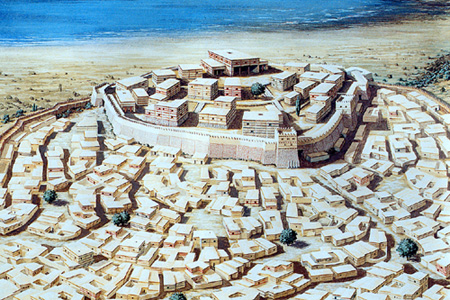
Homer's Troy and modern day Hisarlik

I really enjoyed how in class yesterday, we all seemed to be on the same side, for the first time EVER.

On the question of the Turkish site of Troy, and whether or not it's ok to display it in a certain way (i.e.- the Troy of Homer's Iliad, as opposed to what it may have actually been), I was amazed with myself that I found it ok. As I heard Dr. Greene mention how it's infectious to want to get into the fake Trojan horse, and how people bring their books and walk around assuming that certain events happened in certain places, I found myself thinking about my favourite books, and how I would probably do and feel the same way. When I had the chance to go to England, I was thrilled to visit the actual sites of my favourite author, Jane Austen. I went to the house she used to live, I visited her grave. I was thrilled by this, but if I had been in England a little longer, I would have loved to visit Bath and Lyme and all those other marvelous counties where her works take place, just so that I could imagine my fictitious characters running around these towns. In my case, it's also partly that I would get to see the places that my dearest author loved so much.
Reconstruction of Troy 
The difference with Homer's Troy, to me, is that I wonder what he actually knew of the city Troy, if anything at all. He probably never went there, but we'll never know. For these reasons, it's not ideal to allow for this depiction of the site, as it does a great injustice to the people that actually lived there at the time, what their homes were like, etc. Having never been at the site, I cannot honestly say how much of the "truth" is visible, but I think that the representation of Homer's Troy can do little harm, as people know (or should know) that events did not transpire in the exact way that Homer depicts.
In the end, for me, as long as people know truth versus fiction, it's ok to use this site in a particular way.


Tuesday, 16 October 2012

Repatriation, Take One

When choosing our positions for this week's presentations, I chose something which I knew would be a challenge. I chose the position which was likely to be completely opposite from my own. And I must say that I quite enjoyed it.

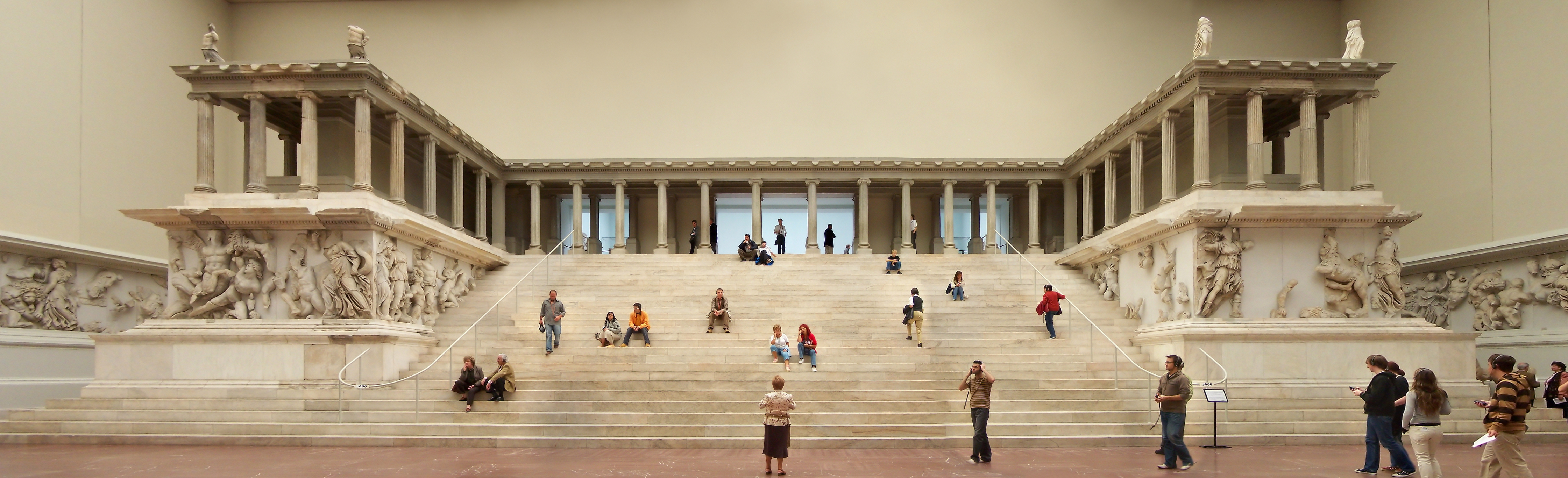
Altar of Zeus at the Pergamon Museum in Berlin
In the position of the Director of the Pergamon Museum in Berlin, I argued that the Altar of Zeus should remain in the Museum and not be returned to Turkey because of several things: first, the altar was rescued from the country in a time when the slabs were being sent off to be burned down for lime, or destroyed for other types of building material, second, their removal was completely legal as the Sultan signed a decree, and later, when the agreement was renegociated, the German government paid for all artifacts concerning the altar to be sent to Germany. Lastly, I argued that the Pergamon museum has taken excellent care of altar over the past 100 plus years, including sheltering them in the World Wars and recently restoring the frieze. 
I'd like to think that I was quite convincing, but the truth of the matter is that I don't think people needed convincing. 
Personally, at the beginning I was completely for the repatriation of the Altar to Turkey, since it is a monument that is missing from the ancient site; however, there are many issues with the repatriation of the altar which could change people's opinions, such as, what will Turkey do with the altar if they get it back? I always envisioned that they would re-mount it on the site where it was taken from, otherwise what's the point? I think that architecture has its greatest impact in its rightful context (I think everything has a greater impact in its original context...), and I don't think that placing the altar in another museum in Turkey would INCREASE that context in any way. My dream is that if the altar is repatriated, it will be set in its original location.

Original location of the Altar of Zeus, modern day Bergama

That being said, even if Turkey just plans to put the altar in another museum, I am for the repatriation of this artifact, because it did come from their land, and they want it back. For whichever reason, it means something special to them, something beside monetary gain. That, for me, is reason enough. Plus, the Berlin Museum has two other really awesome monumental structures in their museum, they could do away with one. If and when I finally get to go to Turkey and to Bergama, I would like to be able to see all the ancient structures that were once in Pergamon in one visit- I don't want to have to then go to Berlin to see the most impressive one. 

Yes, we can't change history. But we can try to make amends for it. No, we can't compensate every family of every slave from the 1800s, but we can make amends by finally treating these people as equal human beings (a thing which a lot of people are still working on...)
No, we can't undo every single wrong that was done in 19th century archaeology, but we can make some amends. This is where repatriation comes in. 

I feel that because I have a lot to say on this subject, I will leave it here for now, but return to talk about the heated debate of the Elgin marbles. 

Monday, 15 October 2012

Titanic Revisited

Well, the talk on Thursday was spectacular. Dr. Delgado is as eloquent as he is entertaining, and he sure had us (at least me!) in a rapture pretty much the entire time he was speaking.
That being said, attending the lecture with Dr. Greene, Justin, and Dave kept me grounded to pay close attention to what he was saying, instead of just losing myself in his eloquent thoughts and well spun stories about Titanic. I give him credit for frequently hinting that he did not want to get into the ethics of certain things, as if anticipating the problems that people would have with what he was describing.

But I don't agree on several points. First, he stated that the RMS Titanic did not plunder the wreck, as the removal of artifacts was completely legal under the law. He followed this statement by announcing that "the law is the law," and to that, I just can't agree. Yes, legally, obviously, the law is the law, yet I believe that for an archaeologist, ethics should play some part in this. The law is not perfect or free from ambiguity, and we, as individuals, should not live life because someone tells us that we can or can't do something. We should do it because it's what we think is right. I realize that I make this point fairly often, but it's because I truly believe that at least in an ideal society, laws are there as guidelines, but if we do our jobs right as human beings, than we should know what is right or not without being forced to do so by some written statement, and we should teach those around us by setting a good example.

Just because some law states that the RMS Titanic team can go about collecting artifacts from the wreck, doesn't mean that it's right to do so, and in the case of setting a precedent, it is most definitely wrong. Why is it legal with the Titanic but not other sites? Is it because the wreck just had its centennial? Because we have so much proof and so many first-hand accounts of what happened?
The fact of the matter is that the RMST team removed artifacts from the wreck in order to SELL them, not in order to study them and learn more about the passengers or that fateful night. That, my friends, should be illegal and forbidden by every moral conscience of every archaeologist.
We are fighting to keep looters out of archaeological sites, to keep the antiquities off the market, and by announcing to the world that not only is it ok to sell these artifacts, but that they're in fact worth millions upon millions of dollars, we are encouraging looters.

In the end, the lecture was fantastic, I really enjoyed meeting Dr. Delgado, and I feel that this experience has contributed to my understanding, or at least contributed a new round of questions to be answered about cultural heritage and archaeological ethics.


Monday, 8 October 2012

Laws, Enforcement, and Endangered Species

I figured that since there is no class tonight due to the long weekend, I'd like to address a question that Dr. Greene posed last week when we were discussing the antiquities trade and private collectors. She asked: Do we need fewer laws and less enforcement, or more laws and more enforcement?
Ideally, I would say it's preferable to have fewer, un/less ambiguous laws, and more enforcement of said laws than more laws which are not as well enforced.

Take for instance the poaching of endangered species in Africa and Asia. The law is simple: do not kill, maim, or dismember these species (such as elephants, panda bears, tigers etc).

Siberian Tiger, a critically endangered subspecies of tiger.
Doesn't this face look like it's worth saving?!
The enforcement of this one, seemingly simple law is, however, not so simple at all.
How difficult could it be?!
Well, that's where the problem really lies. That it IS difficult to enforce these laws, as much for endangered species as it is for the illegal antiquities trade.
Ideally, if we educate individuals to be moral and to know what is right from wrong, they should follow the law without it needing to be strictly enforced. They would just do it because, well, it's what's right. But sadly, while we humans love to preach our values, morality, and superiority, we very few of us are morally upright citizens all the time, and some offenses are much greater than others.
So, since this educational approach sadly only affects part of the population, the rest of the population must be closely monitored for the laws to be upheld.
For poaching, this means setting up perimeters to sanctuaries, tracking the wild animals, having park rangers monitoring the areas constantly, and setting up export and import regulations, among other things.
Again returning to an ideal scenario, if absolutely everything was documented by export and import regulations, these would be an extra security measure on top of the monitoring of sanctuaries because, if you catch a huge elephant tusk being exported from a country in Africa, then you know that poaching has occurred, and the country would then be notified of the illegal action, with the individual paying the penalty.
But sadly, it is simply impossible for customs agents to go through absolutely everything that ever enters or exits a country, just as it is impossible to tag every single endangered animal and to secure every single meter of wildlife preserve. And that is why illegal poaching still occurs and people still get away with it: because the laws, no matter how many or how few, are difficult to enforce.

The same can be said of the antiquities trade. In a way, antiquities are exactly like our endangered animals, except we can't really count how many are still below the earth, waiting to be discovered. We can't have guards at every single gate of every archaeological site combing through everything visitors bring in and out. Even more difficult would be to have protection for sites that have yet to be identified! This would literally require placing some sort of security (guards, camera...) every couple of meters around entire countries, especially antiquities-rich countries such as Greece, Turkey and Italy. This is simply not possible.
In this situation, too, ideally, these looted items would all be caught as they were being exported, and if not at export, then at import, at which point the individual exporting or importing them would be held accountable for their provenience and provenance. Anything short of an official report of excavation or solid provenance, and that individual should be held accountable for his or her crimes.
Quartz Crystal Duck Bowl from Grave Circle B, Mycenae
Doesn't this face, too, look like it's worth saving?

In the end, it doesn't matter how many laws you do or do not have. In order for change to really occur, these laws must be enforced- by countries, communities, and individuals. 

Sunday, 7 October 2012

Titanic Time

I'm very excited for this upcoming week, not because it's a shortened week due to Canadian Thanksgiving, but because this week I will be journeying to Toronto for the first time in order to attend a lecture by Dr. Delgado entitled "Titanic: Every Davit, Every Boiler, Every Shoe."
While I'm naturally excited to attend this lecture since I have been what one could reasonably call 'Titanic obsessed' since I was in the second grade, I'm also really excited to look at the Titanic from a different angle than I have before.

This year is an important year for the Titanic as April 15th marked the 100th anniversary since the "unsinkable" ship sunk off the coast of Newfoundland during its maiden voyage from Southampton to New York City. It's a boating tragedy like few others, mostly due to its status as one of the deadliest peacetime maritime disasters in modern history (1,523 people perished), but also partly due to the fact that many of these deaths could have been prevented if there had been enough lifeboats for those onboard (there were enough for a little over half the passengers, but only one-third of the total passenger and crew capacity). 

But now for a somewhat different perspective: according to the UNESCO guidelines, the wreck is now eligible for International protection, as the 2001 convention on protecting underwater cultural heritage only applies to remains submerged for more than 100 years. This means that now, finally, governments can seize artifacts stolen from the Titanic wreck or prevent any exploration that is deemed unscientific or, perhaps more importantly, unethical. 

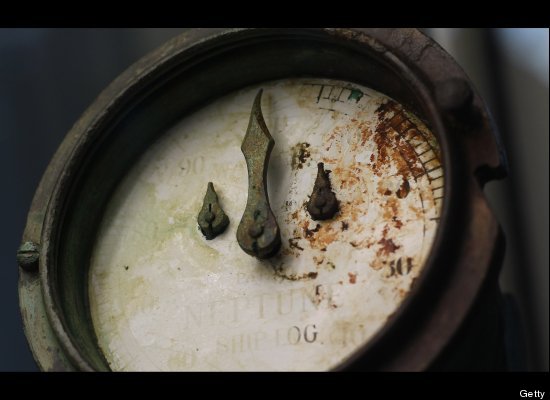
Logometer used to measure Titanic's speed
Speaking of artifacts, RMS Titanic Inc., a division of Premier Exhibitions, was set to auction a collection of artifacts a few days before the shipwreck's centennial. The collection was to be kept intact, and was valued in an appraisal at $189 million. Premier has owned the official salvage rights to the Titanic and its wreck site since the site was discovered in 1985, and has conducted 8 research expeditions since then, the last one in 2010. Now that the site is eligible for protection under the UNESCO convention, what will happen to Premier's ownership rights? What will happen to the artifacts that were removed from the site? Should the deceased people's belongings be "salvaged" in order to be preserved and sold, or should they be left undisturbed at the bottom of the ocean?

Premier's website states that RMS Titanic, Inc. has "honorably" conducted "research expeditions" to the wreck, culminating in its most technically advance dive in 2010. The question from an ethical perspective is: Can it be considered honourable, and can the expeditions be considered as "scientific" when perhaps the main goal was to remove artifacts from the site in order to sell them? 
I can understand both arguments for the removal of artifacts from the wreck site. On the one hand, some of these items are rare and should be preserved for posterity, and the only way to achieve this is to remove them from the site and give them proper treatment. On the other hand, these items, however rare or ordinary they may be, belonged to people who perished in a terrible disaster, and should thus be left where they were deposited, for the respect of the deceased. In a way, the wreck site is one massive graveyard. Is it ethical to dig up early 1900s graveyards in order to learn more about the people living then, or to preserve any goods that they buried for posterity? I think most people would argue that it is NOT. 

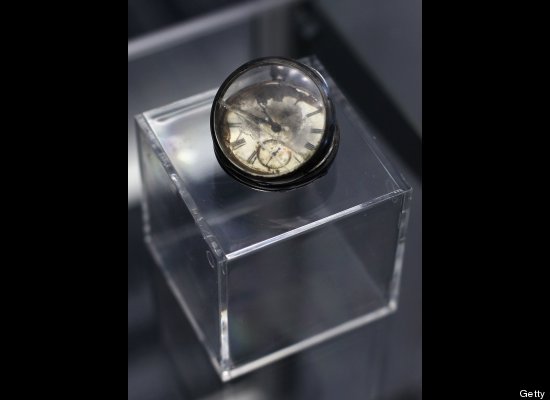
Pocketwatch recovered from the wreck
So why, then, do we ignore this ethical conundrum when we think of the Titanic? 

Going back to the question about how "scientific" these expeditions have been, I DO believe there has been some scientific work in that the site has been "mapped," which is what I presume the lecture on Thursday will focus on, and the evidence from the wreck has led to many theories about what exactly happened on that fateful night in 1912, and how the ship actually sunk. Yes, it's great to have every davit, every boiler, every chandelier, every pocketwatch, every logometer, and every shoe mapped out, but if we have this information, then why remove the artifacts? Does being able to obtain this scientific knowledge excuse the unnecessary removal of artifacts from the wreck site? 
There is no doubt in my mind that since now the wreck is eligible to be protected as a world heritage site these questions will be raised again, and only time will tell what the conclusions will be. 

Sunday, 30 September 2012

Flea market, anyone?

I have been following this story since it appeared in the local Baltimore News a couple of weeks ago, and have since seen it evolve into a matter of Cultural Heritage ownership. Perhaps it was always so, and I was just not as aware of it as I am now. Anyway, today I saw an article about this story on the Illicit Cultural Property Blog and this prompted me to write a little bit about it.

What's the story you might ask?

A lady went to a flea market and bought a framed painting for 7 USD. The painting was later identified to be one of the works of the famous Pierre-Auguste Renoir, most commonly known by just his surname.


Renoir's Paysage Bords de Seine
 It was estimated to be worth between $75,000  and $100,000, and was set to be auctioned off, but the auction has since been cancelled due to reports that the work was stolen from the BMA, the Baltimore Museum of Art. The BMA had the Renoir on loan from famous benefactors Herbert L. May and Sadie Adler May, who purchased the painting in 1926 and bequeathed their collection (over 100 items) to the BMA in 1951, the same year the painting was stolen. The irony of the story is that the woman bought the painting simply for the frame, which one might argue most definitely belongs to the BMA. 


A police report (middle) from 1951 details the theft of a landscape by Renoir
 from the Baltimore Museum of Art. (Courtesy of the Baltimore Police Department.)
It is also quite remarkable that the anonymous lady who bought it at the flea-market, although disappointed that she may not get that big paycheck, has cooperated fully from the start with the FBI. 

The reason this story captivated me, apart from my familiarity with the BMA, is the many issues of ownership it has raised. It is clear to me that artwork is not treated in the same way as other cultural artifacts. The provenance of the painting was completely unknown at the time of the auction, and yet, all the auctioneers needed to legally continue with the sale was proof of the authenticity of the work. 
Now that the painting's provenance has come to light, who does it belong to? Does it belong to the BMA, who was the legal owner prior to the UNESCO convention of 1970? Does it belong to the woman who found it and purchased it (after the 1970s convention) for the bargain price of seven dollars? 
How is this case any different from other cases where a clear provenance is known, but the object was exported from the country of origin before 1970? 

Let's compare it to the Pergamum altar at the Berlin Museum. We know it came from Pergamum, and therefore, having come from Turkish soil, belongs to Turkey. But the Berlin Museum "purchased" and exported it before the UNESCO convention in 1970, and therefore it, too, is a rightful owner. Likewise, the benefactors bequeathed the Renoir to the BMA in 1951, therefore it belongs to the BMA. But the woman legally purchased it from a flea market and therefore, she, too, is the rightful owner. A third claimant may be the insurance company which paid for the lost property in 1951. 

The question I have to ask myself to determine if these statements have any validity is simple: Can something which has been stolen be legally bought? I would say no, but would also advocate that a buyer or seller, who did not know the artifact was stolen, should not be penalized. Seven dollars is not much, but let's say the woman had paid 4,000. Does she get her money back? Does the state pay her? Does the seller have to return the money? Should the BMA have to "buy back" its own stolen painting? For classical artifacts, this is a little different, as the buyers and sellers ARE held responsible for this knowledge. But how often do these rare artifacts end up in garage sales and are purchased for any other purpose other than collecting? Therein lies the difference: collectors must be held accountable for what they purchase, whereas the layman who comes across an extraordinary find may not need to be. 

Clearly, at this stage in my knowledge of these ownership laws and procedures, I have more questions than answers. 

For this particular case, I would say that if it was stolen from the BMA, it should be restored to the BMA, but the woman who bought it should receive some sort of commendation (a plaque of honour? a lifetime membership?)