I'm very excited for this upcoming week, not because it's a shortened week due to Canadian Thanksgiving, but because this week I will be journeying to Toronto for the first time in order to attend a lecture by Dr. Delgado entitled "Titanic: Every Davit, Every Boiler, Every Shoe."
While I'm naturally excited to attend this lecture since I have been what one could reasonably call 'Titanic obsessed' since I was in the second grade, I'm also really excited to look at the Titanic from a different angle than I have before.
This year is an important year for the Titanic as April 15th marked the 100th anniversary since the "unsinkable" ship sunk off the coast of Newfoundland during its maiden voyage from Southampton to New York City. It's a boating tragedy like few others, mostly due to its status as one of the deadliest peacetime maritime disasters in modern history (1,523 people perished), but also partly due to the fact that many of these deaths could have been prevented if there had been enough lifeboats for those onboard (there were enough for a little over half the passengers, but only one-third of the total passenger and crew capacity).
But now for a somewhat different perspective: according to the UNESCO guidelines, the wreck is now eligible for International protection, as the 2001 convention on protecting underwater cultural heritage only applies to remains submerged for more than 100 years. This means that now, finally, governments can seize artifacts stolen from the Titanic wreck or prevent any exploration that is deemed unscientific or, perhaps more importantly, unethical.
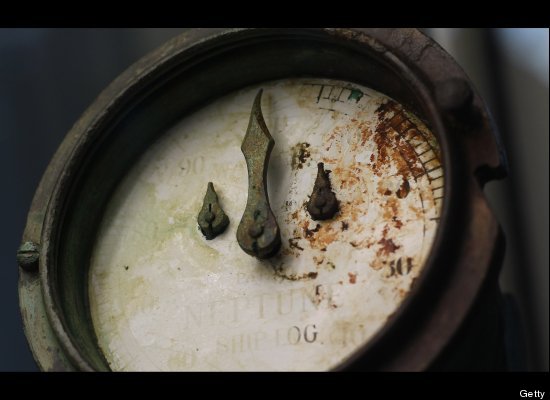 |
| Logometer used to measure Titanic's speed |
Speaking of artifacts, RMS Titanic Inc., a division of Premier Exhibitions, was set to auction a collection of artifacts a few days before the shipwreck's centennial. The collection was to be kept intact, and was valued in an appraisal at $189 million. Premier has owned the official salvage rights to the Titanic and its wreck site since the site was discovered in 1985, and has conducted 8 research expeditions since then, the last one in 2010. Now that the site is eligible for protection under the UNESCO convention, what will happen to Premier's ownership rights? What will happen to the artifacts that were removed from the site? Should the deceased people's belongings be "salvaged" in order to be preserved and sold, or should they be left undisturbed at the bottom of the ocean?
Premier's website states that RMS Titanic, Inc. has "honorably" conducted "research expeditions" to the wreck, culminating in its most technically advance dive in 2010. The question from an ethical perspective is: Can it be considered honourable, and can the expeditions be considered as "scientific" when perhaps the main goal was to remove artifacts from the site in order to sell them?
I can understand both arguments for the removal of artifacts from the wreck site. On the one hand, some of these items are rare and should be preserved for posterity, and the only way to achieve this is to remove them from the site and give them proper treatment. On the other hand, these items, however rare or ordinary they may be, belonged to people who perished in a terrible disaster, and should thus be left where they were deposited, for the respect of the deceased. In a way, the wreck site is one massive graveyard. Is it ethical to dig up early 1900s graveyards in order to learn more about the people living then, or to preserve any goods that they buried for posterity? I think most people would argue that it is NOT.
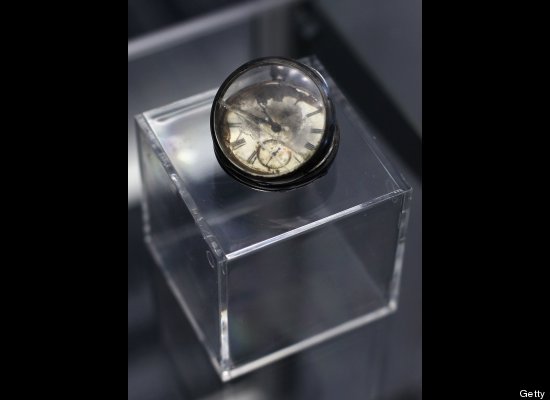 |
| Pocketwatch recovered from the wreck |
So why, then, do we ignore this ethical conundrum when we think of the Titanic?
Going back to the question about how "scientific" these expeditions have been, I DO believe there has been some scientific work in that the site has been "mapped," which is what I presume the lecture on Thursday will focus on, and the evidence from the wreck has led to many theories about what exactly happened on that fateful night in 1912, and how the ship actually sunk. Yes, it's great to have every davit, every boiler, every chandelier, every pocketwatch, every logometer, and every shoe mapped out, but if we have this information, then why remove the artifacts? Does being able to obtain this scientific knowledge excuse the unnecessary removal of artifacts from the wreck site?
There is no doubt in my mind that since now the wreck is eligible to be protected as a world heritage site these questions will be raised again, and only time will tell what the conclusions will be.

No comments:
Post a Comment