The fizzy black beverage seems to be everywhere the last couple of weeks!
The very first reading for my graduate seminar on cultural heritage was an article in the New York Times entitled "The Case for Contamination: No to Purity, No to Tribalism. No to Cultural protectionism. Toward a new Cosmopolitanism." by Kwame A. Appiah.
While the article was engaging, so much so that I sent it to my mother!, one line stuck with me, and when it was mentioned in class, I realized there is much I could share about this one, seemingly simple question.
The question Appiah poses is: What can you tell about a person's soul from the fact that they drink Coca-Cola? Could the question be followed up by "What can you tell about a person's soul from the fact that they eat a quarter pounder at McDonalds? Or drink a cup of Caramel Frappuccino from Starbucks? Or eat a Krispy Kreme glazed doughnut?" Well, you might be able to say a lot about their eating habits and their deteriorating health if they are in the United States, but these questions become relevant in different spheres in other countries, where these franchises are slowly taking over.
I will never forget the day my grandfather told me that Coca-Cola was "las aguas negras del imperialismo Yankee" roughly translated, "the sewage from the imperialism of the United States"
You can imagine how mind boggling it must have been for a 10 year old to realize that one beverage which she's known her whole life has such cultural implications and carries so much political weight!
What can we tell about a culture from the fact that they drink Coca-Cola? A lot of things.
For one, we can tell that they are active in trade, and like most human beings, we are suckers for those things which are deemed "popular" by the elite. If you are a rather poor country farmer in the outskirts of Guatemala, Coke would probably seem the most curious thing on the planet. Wouldn't you want to try that bizarre black beverage that everyone is raving about?
Well, if you live in Burma, you're in luck, because for the first time in 60 years, Coke will be available in your own country! Will it be affordable to the everyday agrarian? Who knows... Will it remain popular once the novelty has died down? These are all questions which only time will answer, but for now, Burma becomes one more coke-drinking country, leaving only two countries sans coca-cola: Cuba, and North Korea (for the full story, you can click here).
No wonder some would describe coke as "the nearest thing to capitalism in a bottle." Tom Sandage, the author of of A History of the World in Six Glasses states that the beverages' entry "into any country is a powerful symbol" and that "the moment Coca-Cola starts shipping is the moment you can say there might be real change going on here." Real change, yes. But does that follow that the change will be welcome by all? That the move away from the traditional needs the intervention of Coca-cola?
Let's think about Cuba, for a moment. It has always been my dream to visit Cuba, especially Havana, and witness a place where time seems to have stood still since the 1950s. The cars are from the 50s, the buildings have that old-style feel... it's what Appiah might call an "unpolluted" place. Cuba is still active in trade, but the big franchises have no presence there, which is perhaps what makes it such a magical place: The US has had no (visible) influence there since the revolution in the late 1950s. Well, if you see someone drinking Coke there, you can pretty much guess that they smuggled it in.
The point is that in the country of origin (in this case, the United States), these dietary choices may not cause much of a reaction except from a health-perspective point of view, whereas in other places, many more things must be considered. For example, if I see a person walking down the streets of Mexico city with a Krisy Kreme doughnut drinking something from a Starbucks cup, I could think "Looks like an unhealthy way to start the day off with" or I could get annoyed and think "Why are they eating this mass-produced, machine-made doughnut, when they could be eating a delicious, perfectly fresh churro from the local store? And why are they drinking something from Starbucks instead of supporting one of the many local or even National Coffee shops?"
This is most likely the attitude my proud grandfather woud have.
While Coca-cola drinking might not reveal anything about a person's soul per se, it might reveal a great deal about that person's culture, such as their willingness to try new things, to trade with foreign countries, to change their customs and adopt something so completely unfamiliar and make it their own.
In the end, Coca-Cola carries political weight because it stands for so many things: capitalism, imperialism, etc.
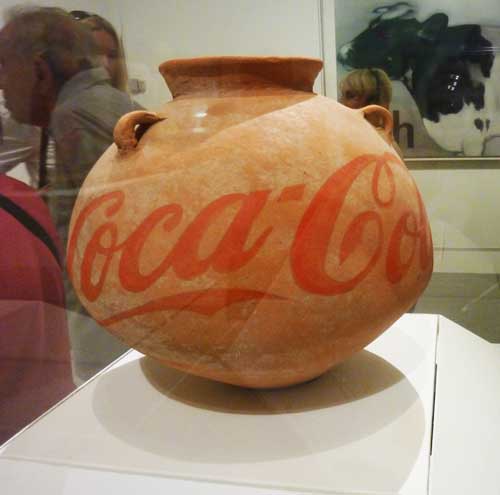 |
| Ai Weiwei, "Neolithic Vase with Coca-Cola Logo," 2010, Mary Boone Image taken from http://www.artsjournal.com/culturegrrl/ |
The very first reading for my graduate seminar on cultural heritage was an article in the New York Times entitled "The Case for Contamination: No to Purity, No to Tribalism. No to Cultural protectionism. Toward a new Cosmopolitanism." by Kwame A. Appiah.
While the article was engaging, so much so that I sent it to my mother!, one line stuck with me, and when it was mentioned in class, I realized there is much I could share about this one, seemingly simple question.
The question Appiah poses is: What can you tell about a person's soul from the fact that they drink Coca-Cola? Could the question be followed up by "What can you tell about a person's soul from the fact that they eat a quarter pounder at McDonalds? Or drink a cup of Caramel Frappuccino from Starbucks? Or eat a Krispy Kreme glazed doughnut?" Well, you might be able to say a lot about their eating habits and their deteriorating health if they are in the United States, but these questions become relevant in different spheres in other countries, where these franchises are slowly taking over.
I will never forget the day my grandfather told me that Coca-Cola was "las aguas negras del imperialismo Yankee" roughly translated, "the sewage from the imperialism of the United States"
You can imagine how mind boggling it must have been for a 10 year old to realize that one beverage which she's known her whole life has such cultural implications and carries so much political weight!
What can we tell about a culture from the fact that they drink Coca-Cola? A lot of things.
For one, we can tell that they are active in trade, and like most human beings, we are suckers for those things which are deemed "popular" by the elite. If you are a rather poor country farmer in the outskirts of Guatemala, Coke would probably seem the most curious thing on the planet. Wouldn't you want to try that bizarre black beverage that everyone is raving about?
Well, if you live in Burma, you're in luck, because for the first time in 60 years, Coke will be available in your own country! Will it be affordable to the everyday agrarian? Who knows... Will it remain popular once the novelty has died down? These are all questions which only time will answer, but for now, Burma becomes one more coke-drinking country, leaving only two countries sans coca-cola: Cuba, and North Korea (for the full story, you can click here).
No wonder some would describe coke as "the nearest thing to capitalism in a bottle." Tom Sandage, the author of of A History of the World in Six Glasses states that the beverages' entry "into any country is a powerful symbol" and that "the moment Coca-Cola starts shipping is the moment you can say there might be real change going on here." Real change, yes. But does that follow that the change will be welcome by all? That the move away from the traditional needs the intervention of Coca-cola?
Let's think about Cuba, for a moment. It has always been my dream to visit Cuba, especially Havana, and witness a place where time seems to have stood still since the 1950s. The cars are from the 50s, the buildings have that old-style feel... it's what Appiah might call an "unpolluted" place. Cuba is still active in trade, but the big franchises have no presence there, which is perhaps what makes it such a magical place: The US has had no (visible) influence there since the revolution in the late 1950s. Well, if you see someone drinking Coke there, you can pretty much guess that they smuggled it in.
The point is that in the country of origin (in this case, the United States), these dietary choices may not cause much of a reaction except from a health-perspective point of view, whereas in other places, many more things must be considered. For example, if I see a person walking down the streets of Mexico city with a Krisy Kreme doughnut drinking something from a Starbucks cup, I could think "Looks like an unhealthy way to start the day off with" or I could get annoyed and think "Why are they eating this mass-produced, machine-made doughnut, when they could be eating a delicious, perfectly fresh churro from the local store? And why are they drinking something from Starbucks instead of supporting one of the many local or even National Coffee shops?"
This is most likely the attitude my proud grandfather woud have.
While Coca-cola drinking might not reveal anything about a person's soul per se, it might reveal a great deal about that person's culture, such as their willingness to try new things, to trade with foreign countries, to change their customs and adopt something so completely unfamiliar and make it their own.
In the end, Coca-Cola carries political weight because it stands for so many things: capitalism, imperialism, etc.

No comments:
Post a Comment