Friday, 26 October 2012

Let Them Have Fakes!

I read an article this morning on the SAFE website about a prominent Rhode Island surgeon and professor at Brown University, Dr. Weiss, who was arrested for trying to sell ancient Coins. Dr. Weiss  pleaded guilty in July to attempted criminal possession of stolen property for trying to sell ancient Greek coins that he believed had been looted from Sicily. Well, it turns out, his prized authentic coins were, in fact, not so authentic after all. They were modern forgeries so well forged, that even experts could not tell, and were only revealed to be forgeries by using a scanning electron microscope. 


Ancient Sicilian Coins 

All that I can really say in response to this article is: GOOD! Good that he got arrested and was convicted for trying to deal what he thought were stolen antiquities from Sicily. Good (great, actually) that they ended up not actually being artifacts but modern forgeries. Good that the people he sold them to paid a colossal amount of money for something fake (that'll teach them!), and good that this has inspired doubt in the mind of every collector about the authenticity of their collectibles. 


The article states 

"If experts who examined the coins at the request of the NYDA’s office were unable to determine the Weiss coins [as] forgeries, what hope do dealers, auctioneers, and collectors have when the next undocumented Greek or Roman coin with scant provenance and a six-figure price tag appears on the market? Will this case prompt coin dealers, auctioneers and collectors to agree that verifiable provenances and scientific testing are necessary for all coins above a certain price level [?]" 
If the article simply stated "...to agree that verifiable provenances are necessary for all artifacts" then I would be much happier. 

If anyone is going to purchase antiquities (and I don't think that anyone should!) they should at least be from sound provenience and not from looted tombs. The way I see it, the more forgeries sold to collectors, the better! They can have their precious expensive replicas (which they don't know are replicas) and leave the real artifacts alone. 


Yes, the problem this raises is that how will we then know what is real and what is fake? Most artifacts can be tested for authenticity, so should an artifact arrive at a Museum, it can then be tested.


Otherwise, let them have fakes!


I think I'd much rather have millons of fakes flying around, then thousands of artifacts looted from sites. 


To read the full article, click here

Tuesday, 23 October 2012

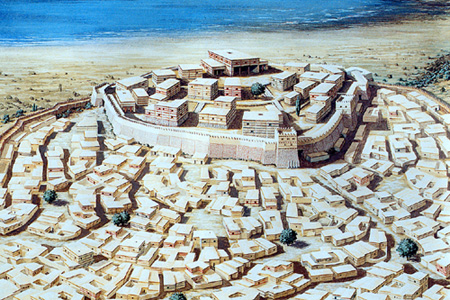
Homer's Troy and modern day Hisarlik

I really enjoyed how in class yesterday, we all seemed to be on the same side, for the first time EVER.

On the question of the Turkish site of Troy, and whether or not it's ok to display it in a certain way (i.e.- the Troy of Homer's Iliad, as opposed to what it may have actually been), I was amazed with myself that I found it ok. As I heard Dr. Greene mention how it's infectious to want to get into the fake Trojan horse, and how people bring their books and walk around assuming that certain events happened in certain places, I found myself thinking about my favourite books, and how I would probably do and feel the same way. When I had the chance to go to England, I was thrilled to visit the actual sites of my favourite author, Jane Austen. I went to the house she used to live, I visited her grave. I was thrilled by this, but if I had been in England a little longer, I would have loved to visit Bath and Lyme and all those other marvelous counties where her works take place, just so that I could imagine my fictitious characters running around these towns. In my case, it's also partly that I would get to see the places that my dearest author loved so much.
Reconstruction of Troy 
The difference with Homer's Troy, to me, is that I wonder what he actually knew of the city Troy, if anything at all. He probably never went there, but we'll never know. For these reasons, it's not ideal to allow for this depiction of the site, as it does a great injustice to the people that actually lived there at the time, what their homes were like, etc. Having never been at the site, I cannot honestly say how much of the "truth" is visible, but I think that the representation of Homer's Troy can do little harm, as people know (or should know) that events did not transpire in the exact way that Homer depicts.
In the end, for me, as long as people know truth versus fiction, it's ok to use this site in a particular way.


Tuesday, 16 October 2012

Repatriation, Take One

When choosing our positions for this week's presentations, I chose something which I knew would be a challenge. I chose the position which was likely to be completely opposite from my own. And I must say that I quite enjoyed it.

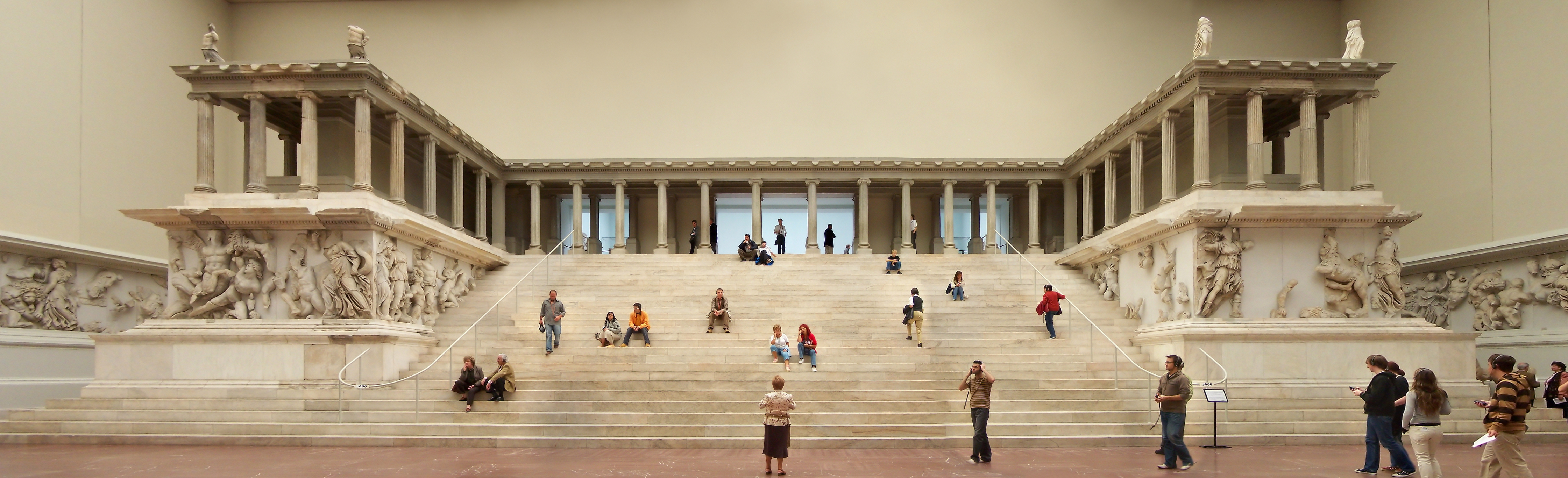
Altar of Zeus at the Pergamon Museum in Berlin
In the position of the Director of the Pergamon Museum in Berlin, I argued that the Altar of Zeus should remain in the Museum and not be returned to Turkey because of several things: first, the altar was rescued from the country in a time when the slabs were being sent off to be burned down for lime, or destroyed for other types of building material, second, their removal was completely legal as the Sultan signed a decree, and later, when the agreement was renegociated, the German government paid for all artifacts concerning the altar to be sent to Germany. Lastly, I argued that the Pergamon museum has taken excellent care of altar over the past 100 plus years, including sheltering them in the World Wars and recently restoring the frieze. 
I'd like to think that I was quite convincing, but the truth of the matter is that I don't think people needed convincing. 
Personally, at the beginning I was completely for the repatriation of the Altar to Turkey, since it is a monument that is missing from the ancient site; however, there are many issues with the repatriation of the altar which could change people's opinions, such as, what will Turkey do with the altar if they get it back? I always envisioned that they would re-mount it on the site where it was taken from, otherwise what's the point? I think that architecture has its greatest impact in its rightful context (I think everything has a greater impact in its original context...), and I don't think that placing the altar in another museum in Turkey would INCREASE that context in any way. My dream is that if the altar is repatriated, it will be set in its original location.

Original location of the Altar of Zeus, modern day Bergama

That being said, even if Turkey just plans to put the altar in another museum, I am for the repatriation of this artifact, because it did come from their land, and they want it back. For whichever reason, it means something special to them, something beside monetary gain. That, for me, is reason enough. Plus, the Berlin Museum has two other really awesome monumental structures in their museum, they could do away with one. If and when I finally get to go to Turkey and to Bergama, I would like to be able to see all the ancient structures that were once in Pergamon in one visit- I don't want to have to then go to Berlin to see the most impressive one. 

Yes, we can't change history. But we can try to make amends for it. No, we can't compensate every family of every slave from the 1800s, but we can make amends by finally treating these people as equal human beings (a thing which a lot of people are still working on...)
No, we can't undo every single wrong that was done in 19th century archaeology, but we can make some amends. This is where repatriation comes in. 

I feel that because I have a lot to say on this subject, I will leave it here for now, but return to talk about the heated debate of the Elgin marbles. 

Monday, 15 October 2012

Titanic Revisited

Well, the talk on Thursday was spectacular. Dr. Delgado is as eloquent as he is entertaining, and he sure had us (at least me!) in a rapture pretty much the entire time he was speaking.
That being said, attending the lecture with Dr. Greene, Justin, and Dave kept me grounded to pay close attention to what he was saying, instead of just losing myself in his eloquent thoughts and well spun stories about Titanic. I give him credit for frequently hinting that he did not want to get into the ethics of certain things, as if anticipating the problems that people would have with what he was describing.

But I don't agree on several points. First, he stated that the RMS Titanic did not plunder the wreck, as the removal of artifacts was completely legal under the law. He followed this statement by announcing that "the law is the law," and to that, I just can't agree. Yes, legally, obviously, the law is the law, yet I believe that for an archaeologist, ethics should play some part in this. The law is not perfect or free from ambiguity, and we, as individuals, should not live life because someone tells us that we can or can't do something. We should do it because it's what we think is right. I realize that I make this point fairly often, but it's because I truly believe that at least in an ideal society, laws are there as guidelines, but if we do our jobs right as human beings, than we should know what is right or not without being forced to do so by some written statement, and we should teach those around us by setting a good example.

Just because some law states that the RMS Titanic team can go about collecting artifacts from the wreck, doesn't mean that it's right to do so, and in the case of setting a precedent, it is most definitely wrong. Why is it legal with the Titanic but not other sites? Is it because the wreck just had its centennial? Because we have so much proof and so many first-hand accounts of what happened?
The fact of the matter is that the RMST team removed artifacts from the wreck in order to SELL them, not in order to study them and learn more about the passengers or that fateful night. That, my friends, should be illegal and forbidden by every moral conscience of every archaeologist.
We are fighting to keep looters out of archaeological sites, to keep the antiquities off the market, and by announcing to the world that not only is it ok to sell these artifacts, but that they're in fact worth millions upon millions of dollars, we are encouraging looters.

In the end, the lecture was fantastic, I really enjoyed meeting Dr. Delgado, and I feel that this experience has contributed to my understanding, or at least contributed a new round of questions to be answered about cultural heritage and archaeological ethics.


Monday, 8 October 2012

Laws, Enforcement, and Endangered Species

I figured that since there is no class tonight due to the long weekend, I'd like to address a question that Dr. Greene posed last week when we were discussing the antiquities trade and private collectors. She asked: Do we need fewer laws and less enforcement, or more laws and more enforcement?
Ideally, I would say it's preferable to have fewer, un/less ambiguous laws, and more enforcement of said laws than more laws which are not as well enforced.

Take for instance the poaching of endangered species in Africa and Asia. The law is simple: do not kill, maim, or dismember these species (such as elephants, panda bears, tigers etc).

Siberian Tiger, a critically endangered subspecies of tiger.
Doesn't this face look like it's worth saving?!
The enforcement of this one, seemingly simple law is, however, not so simple at all.
How difficult could it be?!
Well, that's where the problem really lies. That it IS difficult to enforce these laws, as much for endangered species as it is for the illegal antiquities trade.
Ideally, if we educate individuals to be moral and to know what is right from wrong, they should follow the law without it needing to be strictly enforced. They would just do it because, well, it's what's right. But sadly, while we humans love to preach our values, morality, and superiority, we very few of us are morally upright citizens all the time, and some offenses are much greater than others.
So, since this educational approach sadly only affects part of the population, the rest of the population must be closely monitored for the laws to be upheld.
For poaching, this means setting up perimeters to sanctuaries, tracking the wild animals, having park rangers monitoring the areas constantly, and setting up export and import regulations, among other things.
Again returning to an ideal scenario, if absolutely everything was documented by export and import regulations, these would be an extra security measure on top of the monitoring of sanctuaries because, if you catch a huge elephant tusk being exported from a country in Africa, then you know that poaching has occurred, and the country would then be notified of the illegal action, with the individual paying the penalty.
But sadly, it is simply impossible for customs agents to go through absolutely everything that ever enters or exits a country, just as it is impossible to tag every single endangered animal and to secure every single meter of wildlife preserve. And that is why illegal poaching still occurs and people still get away with it: because the laws, no matter how many or how few, are difficult to enforce.

The same can be said of the antiquities trade. In a way, antiquities are exactly like our endangered animals, except we can't really count how many are still below the earth, waiting to be discovered. We can't have guards at every single gate of every archaeological site combing through everything visitors bring in and out. Even more difficult would be to have protection for sites that have yet to be identified! This would literally require placing some sort of security (guards, camera...) every couple of meters around entire countries, especially antiquities-rich countries such as Greece, Turkey and Italy. This is simply not possible.
In this situation, too, ideally, these looted items would all be caught as they were being exported, and if not at export, then at import, at which point the individual exporting or importing them would be held accountable for their provenience and provenance. Anything short of an official report of excavation or solid provenance, and that individual should be held accountable for his or her crimes.
Quartz Crystal Duck Bowl from Grave Circle B, Mycenae
Doesn't this face, too, look like it's worth saving?

In the end, it doesn't matter how many laws you do or do not have. In order for change to really occur, these laws must be enforced- by countries, communities, and individuals. 

Sunday, 7 October 2012

Titanic Time

I'm very excited for this upcoming week, not because it's a shortened week due to Canadian Thanksgiving, but because this week I will be journeying to Toronto for the first time in order to attend a lecture by Dr. Delgado entitled "Titanic: Every Davit, Every Boiler, Every Shoe."
While I'm naturally excited to attend this lecture since I have been what one could reasonably call 'Titanic obsessed' since I was in the second grade, I'm also really excited to look at the Titanic from a different angle than I have before.

This year is an important year for the Titanic as April 15th marked the 100th anniversary since the "unsinkable" ship sunk off the coast of Newfoundland during its maiden voyage from Southampton to New York City. It's a boating tragedy like few others, mostly due to its status as one of the deadliest peacetime maritime disasters in modern history (1,523 people perished), but also partly due to the fact that many of these deaths could have been prevented if there had been enough lifeboats for those onboard (there were enough for a little over half the passengers, but only one-third of the total passenger and crew capacity). 

But now for a somewhat different perspective: according to the UNESCO guidelines, the wreck is now eligible for International protection, as the 2001 convention on protecting underwater cultural heritage only applies to remains submerged for more than 100 years. This means that now, finally, governments can seize artifacts stolen from the Titanic wreck or prevent any exploration that is deemed unscientific or, perhaps more importantly, unethical. 

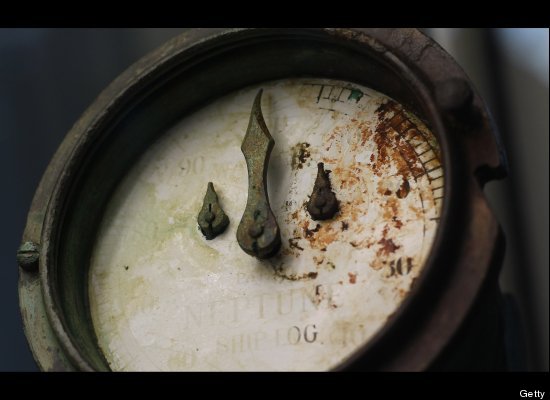
Logometer used to measure Titanic's speed
Speaking of artifacts, RMS Titanic Inc., a division of Premier Exhibitions, was set to auction a collection of artifacts a few days before the shipwreck's centennial. The collection was to be kept intact, and was valued in an appraisal at $189 million. Premier has owned the official salvage rights to the Titanic and its wreck site since the site was discovered in 1985, and has conducted 8 research expeditions since then, the last one in 2010. Now that the site is eligible for protection under the UNESCO convention, what will happen to Premier's ownership rights? What will happen to the artifacts that were removed from the site? Should the deceased people's belongings be "salvaged" in order to be preserved and sold, or should they be left undisturbed at the bottom of the ocean?

Premier's website states that RMS Titanic, Inc. has "honorably" conducted "research expeditions" to the wreck, culminating in its most technically advance dive in 2010. The question from an ethical perspective is: Can it be considered honourable, and can the expeditions be considered as "scientific" when perhaps the main goal was to remove artifacts from the site in order to sell them? 
I can understand both arguments for the removal of artifacts from the wreck site. On the one hand, some of these items are rare and should be preserved for posterity, and the only way to achieve this is to remove them from the site and give them proper treatment. On the other hand, these items, however rare or ordinary they may be, belonged to people who perished in a terrible disaster, and should thus be left where they were deposited, for the respect of the deceased. In a way, the wreck site is one massive graveyard. Is it ethical to dig up early 1900s graveyards in order to learn more about the people living then, or to preserve any goods that they buried for posterity? I think most people would argue that it is NOT. 

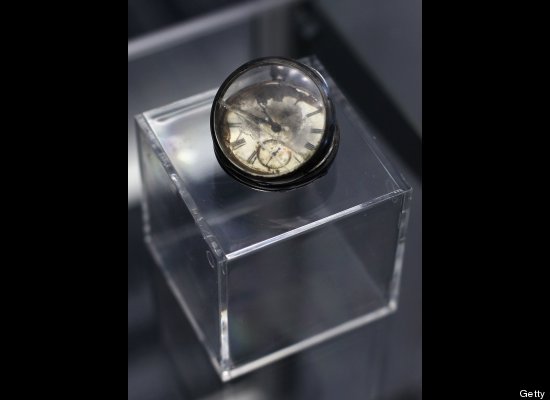
Pocketwatch recovered from the wreck
So why, then, do we ignore this ethical conundrum when we think of the Titanic? 

Going back to the question about how "scientific" these expeditions have been, I DO believe there has been some scientific work in that the site has been "mapped," which is what I presume the lecture on Thursday will focus on, and the evidence from the wreck has led to many theories about what exactly happened on that fateful night in 1912, and how the ship actually sunk. Yes, it's great to have every davit, every boiler, every chandelier, every pocketwatch, every logometer, and every shoe mapped out, but if we have this information, then why remove the artifacts? Does being able to obtain this scientific knowledge excuse the unnecessary removal of artifacts from the wreck site? 
There is no doubt in my mind that since now the wreck is eligible to be protected as a world heritage site these questions will be raised again, and only time will tell what the conclusions will be.