When we think about material culture, we tend to think about its importance in terms of what it tells us about the past, providing a window of understanding or insight into an ancient culture. For example, the White-ground Lekythoi of the 5th century BCE provide an insight into funerary rituals, not only by the function and context of the vessels themselves, but also by the scenes depicted on said vessels.
If the provenience of an artifact is critical to its meaning, and thus artifacts without provenience are worthless, are Cycladic Figurines, then, worthless?

Many would argue that yes, any artifact without context is, in some ways, worthless. They are not worth anything in the sense that they cannot tell us anything truly specific about the past. The figurines show variations, like any other corpus, but it is almost impossible to categorize these variations through time and space with any degree of certainty. The main questions archaeologists want to know are: what was their function? What were they used for? Were they votive offerings? Were they grave goods? These are questions that we may guess at, but until more figurines are discovered with archaeological contexts, we cannot be sure of the answer.
To put it into perspective, here are some numbers to consider:
1,400 tombs were excavated by archaeologists, which yielded 140 figurines with context (meaning that 10% of tombs had figurines).
There are 1,600 known figurines, which means that 1,460 figurines come from illicit excavations. This number is bad in and of itself, but considering that only 10% of tombs yield figurines, we may reasonably deduct that roughly 14,600 tombs were excavated illegally.
From an aspiring archaeologist's point of view, there's something to be said about the ethics of desecrating the tombs, just for monetary gain.
For me, these objects, even without provenience, are precious. The mere fact that they were sculpted by ancient hands and survive against all odds through time to the present day, some over 4,000 years, makes them extremely precious and valuable. And yes, their exact function is not known, but here's one artifact to consider:
Discovered in 1908 by Luigi Pernier, the disk was unearthed during a proper excavation of the Minoan 'palace' of Phaistos. We have its provenience. We have the excavation notes, scholars have studied it for 100 years, and yet, we have no idea what it was used for. It may be a calendar, or a game of some sort, or something entirely different. It may even be a hoax. The point is that even with provenience, this item may be a fake made by the archaeologist and it's meaning remains unknown, much the same as the hoards of Cycladic figurines.
Are these items any less valuable because we don't know their meaning? My personal opinion is that there is much more to their value than just their scientific or artistic value, making them, indeed, still quite valuable without provenience or a fully-understood meaning.
If the provenience of an artifact is critical to its meaning, and thus artifacts without provenience are worthless, are Cycladic Figurines, then, worthless?

Many would argue that yes, any artifact without context is, in some ways, worthless. They are not worth anything in the sense that they cannot tell us anything truly specific about the past. The figurines show variations, like any other corpus, but it is almost impossible to categorize these variations through time and space with any degree of certainty. The main questions archaeologists want to know are: what was their function? What were they used for? Were they votive offerings? Were they grave goods? These are questions that we may guess at, but until more figurines are discovered with archaeological contexts, we cannot be sure of the answer.
To put it into perspective, here are some numbers to consider:
1,400 tombs were excavated by archaeologists, which yielded 140 figurines with context (meaning that 10% of tombs had figurines).
There are 1,600 known figurines, which means that 1,460 figurines come from illicit excavations. This number is bad in and of itself, but considering that only 10% of tombs yield figurines, we may reasonably deduct that roughly 14,600 tombs were excavated illegally.
From an aspiring archaeologist's point of view, there's something to be said about the ethics of desecrating the tombs, just for monetary gain.
For me, these objects, even without provenience, are precious. The mere fact that they were sculpted by ancient hands and survive against all odds through time to the present day, some over 4,000 years, makes them extremely precious and valuable. And yes, their exact function is not known, but here's one artifact to consider:
The Phaistos disk.
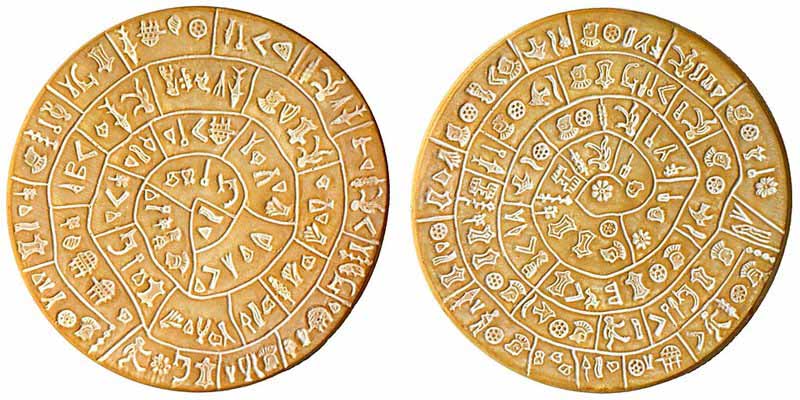 |
| Both sides of the Phaistos Disk |
Are these items any less valuable because we don't know their meaning? My personal opinion is that there is much more to their value than just their scientific or artistic value, making them, indeed, still quite valuable without provenience or a fully-understood meaning.

Has carbon dating been done on this piece?
ReplyDeleteWhich piece? The Phaistos disk cannot be carbon dated because it is not made out of organic material, but the Heraklion museum refuses to let it be dated, citing that the procedures would "damage" the artifact (they need to drill a tiny hole). The Cycladic figurines also cannot be carbon dated for the same reason that the ones which survive are not made out of organic materials.
ReplyDelete